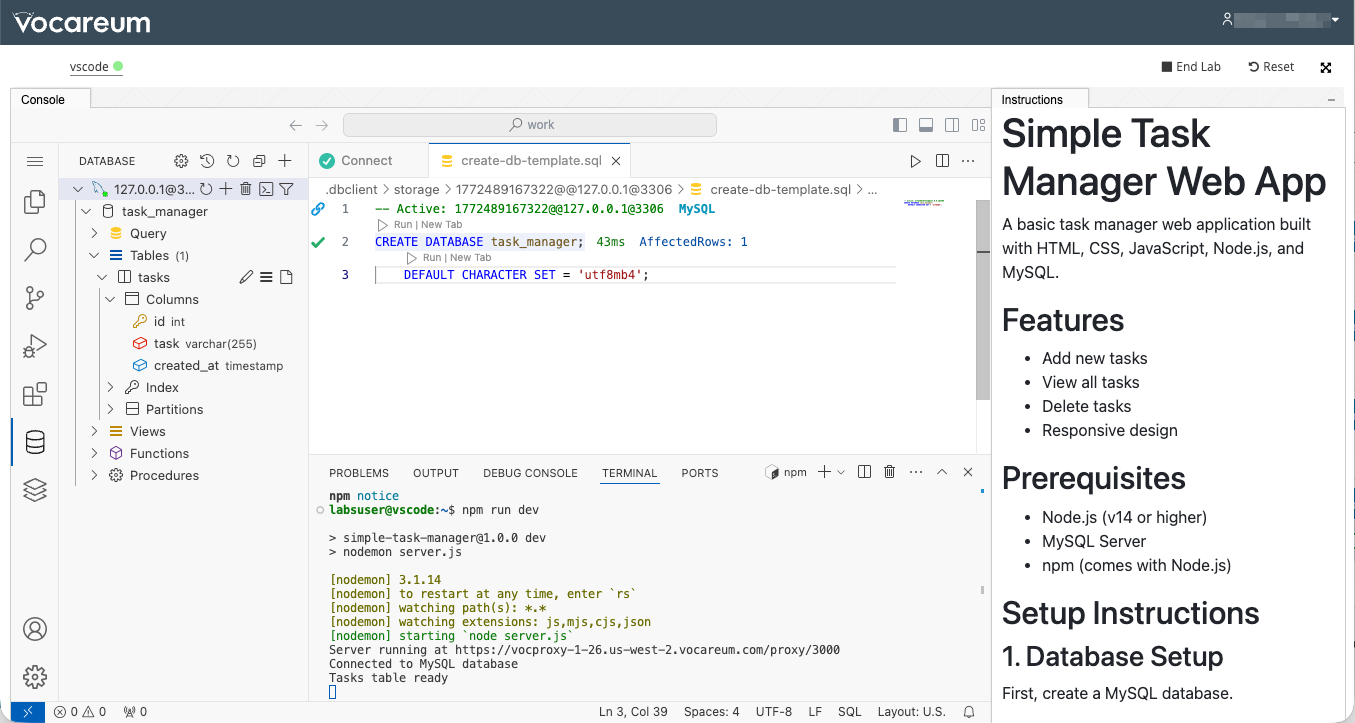
Instantly provision fully managed MySQL, PostgreSQL, and MongoDB databases for every student. Our platform handles all the setup, configuration, and administration, so your learners can stop wrestling with installations and start writing queries from day one. Deliver a seamless, scalable, and assessable database curriculum with Vocareum.
From relational fundamentals to modern NoSQL, provide the exact database environment your curriculum requires.
Mastering SQL with MySQL & PostgreSQL
Provide learners with their own private instance of the world’s most popular open-source relational databases. Perfect for introductory database courses, advanced data analysis, and building robust backend applications.
Building Modern Apps with MongoDB
Explore the flexibility of document databases with a fully managed MongoDB instance. Ideal for teaching modern full-stack development, big data concepts, and handling unstructured data.
Easy Management with Web-Based Clients
Students can connect to and manage their databases using familiar web-based clients like Adminer or pgAdmin, or programmatically from our integrated IDEs and Notebooks. No local client software required.
Automated Query Assessment: Automatically run and grade SQL scripts.
LMS Integration: Manage your course and grades in one place.
Pre-loaded Datasets: Start every lab with a clean, consistent dataset.
Secure, Isolated Instances: Ensure every student has their own private database.
Move beyond manually checking SQL scripts. Our powerful assessment engine can execute student queries against a reference dataset, compare the results, check for schema modifications, and even grade the efficiency of a query, providing instant, objective feedback at scale.
Eliminate the security and data integrity risks of using shared database servers. The Vocareum platform provisions a completely separate, sandboxed database instance for every single student, ensuring their work is private and can’t be impacted by others.
Empower students to experiment without fear. If they corrupt a table or delete critical data, they can simply restart the lab to get a fresh, clean instance pre-loaded with the original sample data. This encourages exploration and removes the frustration of irreversible mistakes.
Teach the fundamentals of database design, normalization, and SQL from the ground up. Provide a clean, simple environment for students to master the most critical data language in the world.
Benefits:
Eliminate weeks of troubleshooting local database installations.
Automatically grade hundreds of SQL query submissions in minutes.
Ensure every student starts with an identical database schema.
Enable students to build and connect their web applications to a persistent, real-world database backend, just as they would in a professional setting.
Benefits:
Teach the full application lifecycle, from front-end to data persistence.
Allow students to work with both relational (PostgreSQL) and NoSQL (MongoDB) backends.
Provide a stable, managed database that works seamlessly with our IDEs.
Provide analysts-in-training with large, realistic datasets hosted in a high-performance database. Let them connect BI tools or use notebooks to query and analyze data without needing to be database administrators.
Benefits:
Host large, complex datasets that are impractical for local machines.
Allow learners to practice writing complex analytical queries and joins.
Focus on data analysis, not database administration.
They are completely private instances. Each student receives their own dedicated database server process and storage, ensuring their work is fully isolated from all other users. This is critical for both security and for providing a stable, consistent learning environment.
Students have multiple options. For direct interaction, we provide a link to a web-based administration tool like Adminer. For programmatic access, they can connect from code running in our other lab environments, like a Python script in our VS Code IDE or a Jupyter Notebook, using standard database connection libraries.
Yes, this is a core feature. As an instructor, you provide a setup SQL script or database dump. Our platform uses that to automatically create the schema and populate the data for every student at the start of the lab, ensuring everyone begins with a consistent environment.
You can assess student work in several ways. The most common method is to provide a “test” SQL script that our grading engine runs against the student’s modified database. The script can query tables, check for specific values, or compare schemas to a reference solution to determine a grade.
Book a demo to see the platform in action, or explore our case studies to discover how Vocareum can transform your training or educational program.